News

Creating your club now happens on the site

  • New

/crear-club is live: the new flow behind the Create my club button. You tell us how your brand sells and go straight to what fits you. If you sell online with Tiendanube, straight to signing up in the dashboard and your club is running in two minutes; for everything else, you pick a time and leave with a half-hour meeting booked.

Until now, booking that meeting went through a third-party calendar embedded in a window over the page. We replaced it with a scheduler we built ourselves, inside the site and connected to the team's real availability: the times you see are genuinely free, they show in your time zone, and the meeting comes with its video call link.

How it works

  • You tell us how you sell (online, in stores, both or something custom) and, if you sell online, on which platform.
  • Anyone selling with Tiendanube goes straight to signing up in the dashboard, with their brand name already filled in.
  • Everyone else answers a few short questions about the brand and the business, so the meeting does not start from scratch.
  • You pick the time first and the contact details come last, with the slot already in view. You can add guests from your team: they all get the confirmation, with the file for their calendar.

The meeting runs itself

Every meeting has its own page: from the link in the confirmation you can see it, reschedule it or cancel it without writing to anyone. And the reminders go out on their own, by email to every guest and by WhatsApp to whoever booked: a day before, an hour before and when it starts.

Loyalty Engine

  • New

The Loyalty Engine shipped as an API: members, points, tiers, segments, rewards and webhooks running underneath your app, your site or the system you already have. The screens and the brand are yours, and Loybox stays invisible in the stack.

It is a new vertical, not one more feature. The other two products deliver the experience ready-made (the club inside your Tiendanube store, or your own loyalty app). Here we do not deliver an experience: we deliver the engine. The company that reaches this product already has its app, its site or its internal system, and what it is missing is the loyalty logic underneath.

And it brings something the other two do not have: the program does not have to be for end customers. The same engine powers programs for employees and sales teams, for the distributor network, for collaborators and partners, and for strategic partners, each one with the mechanics that audience calls for (points per purchase, challenges for hitting a target, cashback on volume, referrals or tiers with fixed benefits).

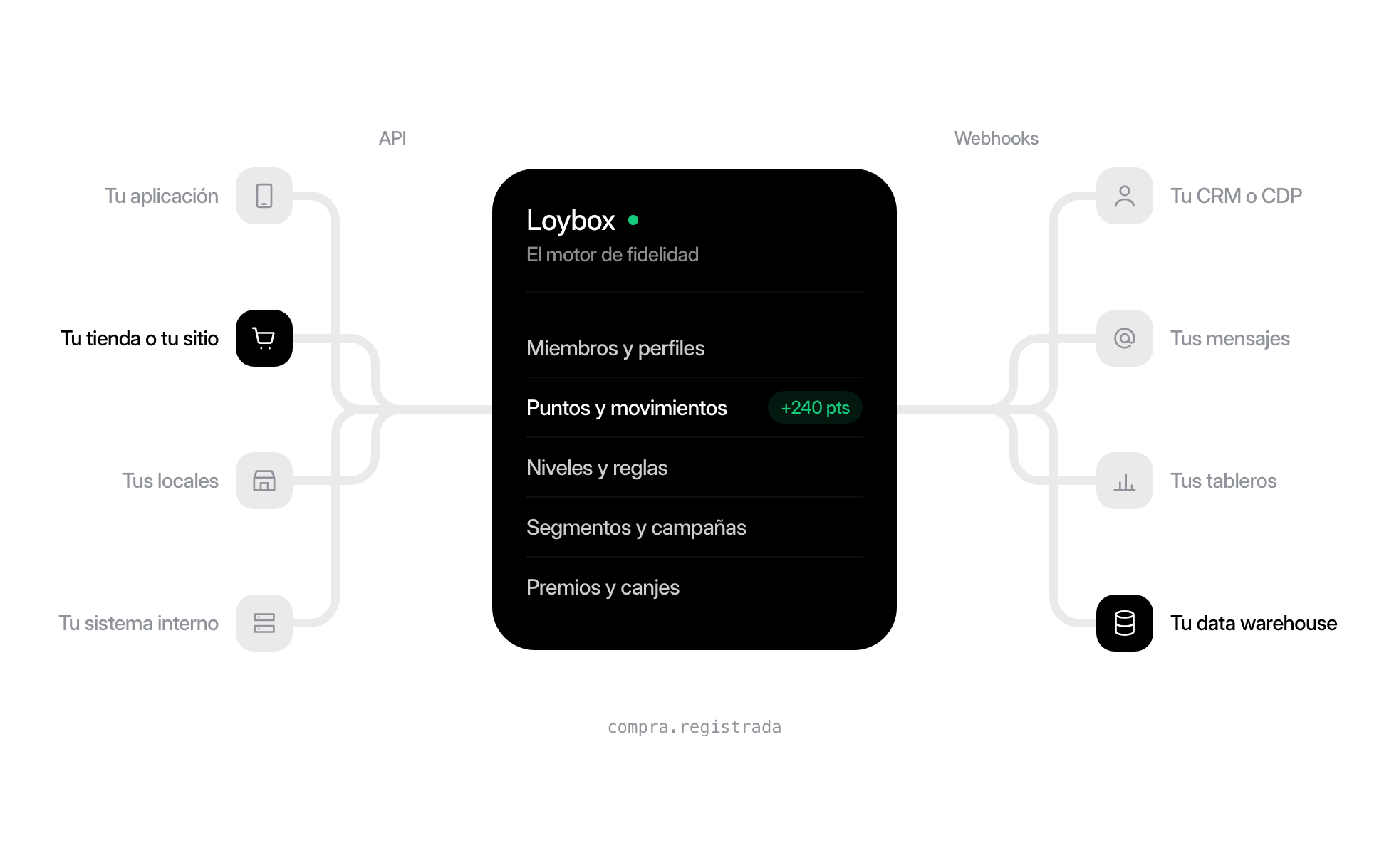
The engine diagram: on the left your app, your online store, your brick-and-mortar stores and your internal system come in through the API; in the center Loybox handles members, points, tiers, segments and rewards; on the right webhooks go out to your CRM, your messaging, your dashboards and your data warehouse. A registered purchase credits 240 points and notifies the data warehouse.

What the engine handles

  • Members: sign-up, profile, real-time balance, history and tier with its progress.
  • Transactions: what earns points, the multipliers of each rule, redemptions with balance validation and reversals when there is a return.
  • Segments and campaigns: which segment each member falls into, the lists to use in your frontend and the campaigns triggered from your system.
  • Rewards: the catalog with its cost in points, the redemption, the order status and the logistics of physical rewards.
  • Webhooks: the engine calls your endpoint when something happens, so your product reacts without having to ask.

You do not integrate it alone

Your team does not start with the documentation open and nothing else. We look at your stack with your technical team, the program is designed by the team that will run it afterwards, it is written against a test environment with its own credentials, and support after go live is direct with the people who worked with you.

There is no off-the-shelf plan: the scope depends on how many audiences the program has, which systems it integrates with and what volume it handles, so the number comes out of a meeting.

The whole program runs from a single place

  • New

The new Loybox dashboard is live, built for the program of an online store. From there you connect your store, set up how the club looks, put the campaigns together and see all your members, without having to ask us for anything and without jumping between screens.

It also ships with the new Loybox identity, the same one you see on this site. It is not just a change of colors: the dashboard was rebuilt around how a program actually gets used, which is coming in, seeing what is happening with your members and deciding the next campaign.

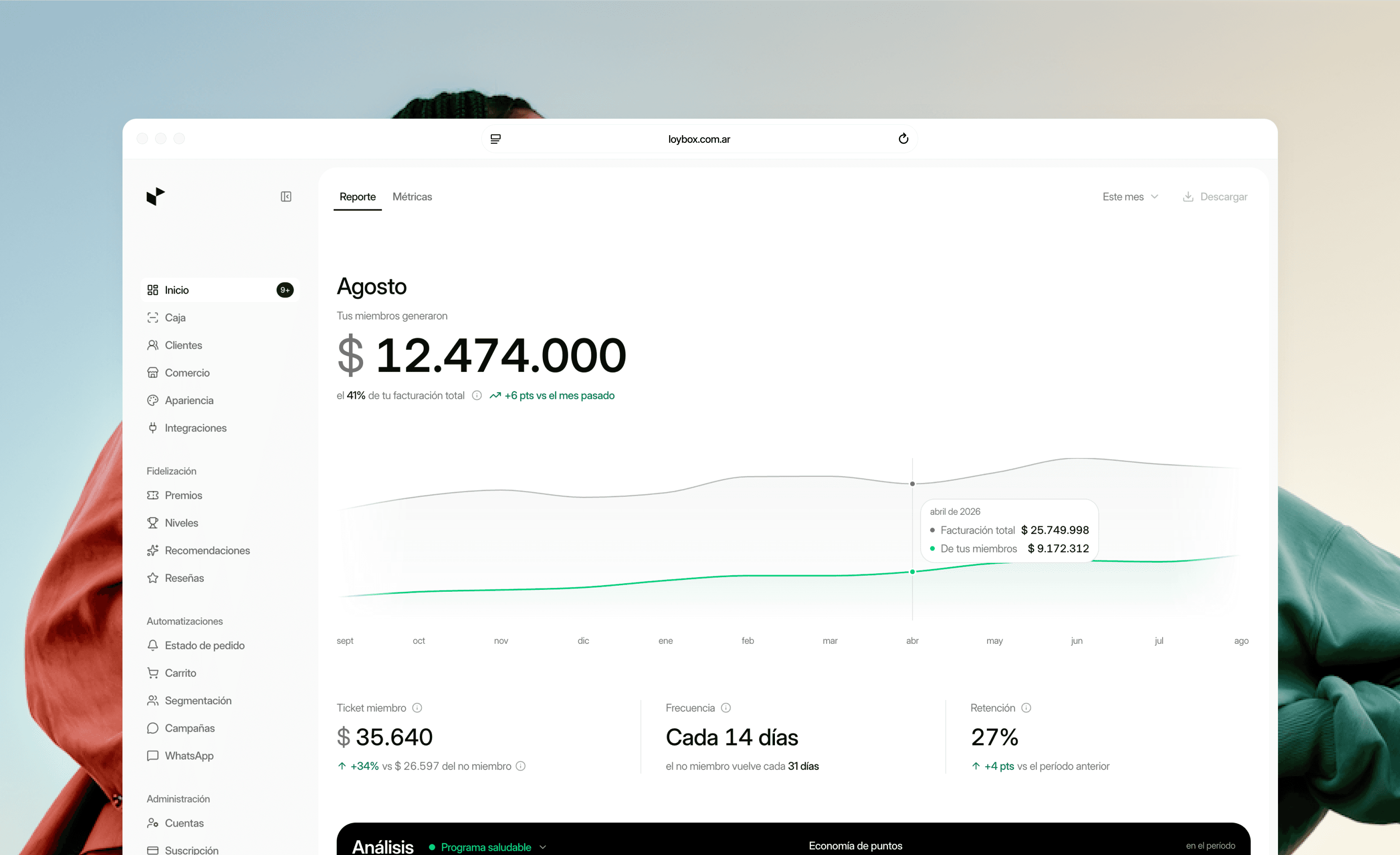
The Loybox dashboard report: members generated $12,474,000 in August, 41% of total revenue, with the average order value, frequency and retention for the period.

What you can do from the dashboard

  • Connect your online store and get the club running.
  • Set up the look: how the club appears in your store, with your name and your colors.
  • Define how points are earned and build the rewards catalog.
  • Build the club tiers and the conditions for moving from one to the next.
  • Create and follow campaigns, with your base already sorted into groups.
  • Turn on the referral program and see who brought whom.
  • Get review requests going after every purchase.
  • Turn on recommendations and abandoned cart recovery.
  • See all your members: who they are, how many points they have and what they redeemed.

A new Loybox

  • Milestone

Loybox used to be a loyalty app that brands joined. Today it is the way each brand builds its own program: customized, built for the online store (and above all for Tiendanube) and, when the brand wants it, with its own loyalty app.

The change is not about screens, it is about who the program belongs to. The Loybox app is still running and we still maintain it, so nobody has to move anywhere. What we learned along the way is that the brand did not need one more app on its customer's phone: it needed the program to be its own, with its rules, its rewards and its name in front.

And that the program has to be where the purchase actually happens. That is why the focus moved to ecommerce: if the customer earns points at checkout and redeems them in the same cart, the program gets used. If they have to remember to open something else after buying, it does not.

What Loybox is now

  • Customized loyalty programs: the rules, the tiers and the rewards are defined by each brand, not by a template of ours.
  • Focus on the online store, with a Tiendanube integration: the customer earns and redeems while buying, without leaving the store.
  • Custom loyalty apps for the brands that want their own, with their identity and not ours.

What does not change

The Loybox app is still standing and supported. The brands using it can stay there as long as they want, and anyone who wants to move to their own program does it without losing the members or the points they already collected.